
Dermal Fillers

Your face gradually loses fat, bone density, and collagen, starting in your late twenties.  At Savage Serenity, Angela Savage, RN, approaches dermal fillers as full face rejuvenation. She doesn’t just fill a line because you point at it. She looks at your whole face and figures out what’s actually causing that line to show up. Usually, it’s a loss of volume somewhere above it. Restore the volume, and the line often improves on its own.

Start your Transformation Today

Dermal Fillers

What Dermal Fillers Are And How They Work

Dermal fillers are injectable gels that add volume underneath the skin. Fillers work differently from Botox. Botox relaxes muscles to prevent wrinkles from forming with movement. Fillers physically fill in areas where volume has been lost. If a wrinkle is there when your face is completely still, that’s usually a volume problem, and filler is the right tool.

The results are immediate. You walk out of the appointment with visible improvement. There will be swelling on top of that for a few days, so the final result takes about 2 to 4 weeks to settle fully. Most hyaluronic acid fillers last anywhere from 9 to 18 months, depending on the product and where it’s placed.
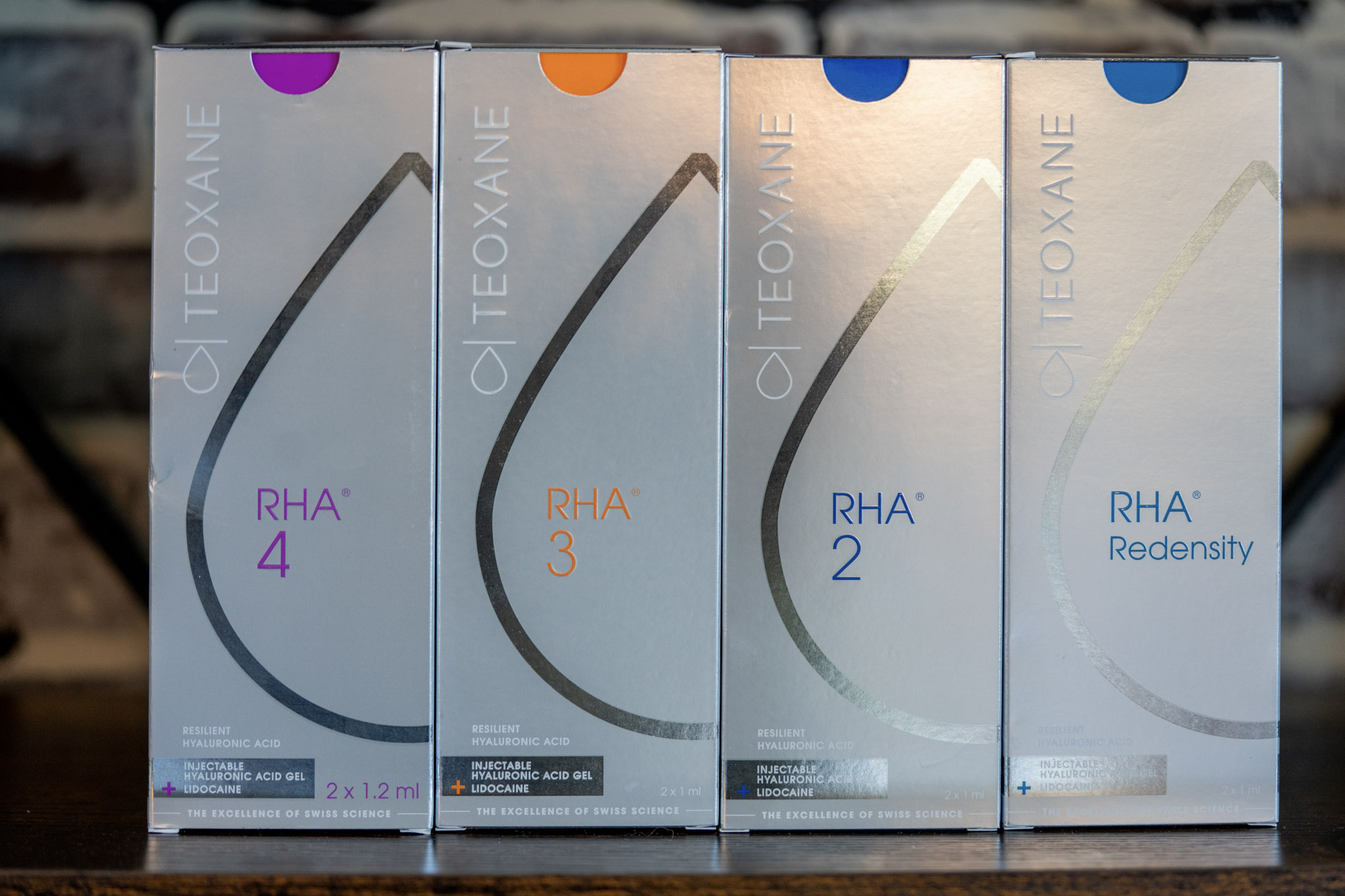
Dermal Filler Products We Use

Different areas of the face need different types of filler. A product that works well deep on the cheekbone would be too thick for the lips. Angela picks the product based on where it’s going and what it needs to do.

RHA Collection

This is the primary line Angela reaches for at Savage Serenity. RHA stands for Resilient Hyaluronic Acid. These fillers are cross-linked so they can stretch and move with your facial expressions, rather than sitting stiff under the skin.

RHA 4 is the firmest in the collection. Angela uses it deep on the bone for cheek augmentation and jawline definition. It provides structure and lift.

RHA 3 is a medium-density filler. It works well for nasolabial folds and areas that need volume but also need to move naturally when you talk or chew.

RHA Redensity is the softest option. Angela layers this over firmer fillers to smooth the skin surface and achieve a more natural finish. It’s also used around the eyes and for fine lines.

Juvederm Voluma and Juvederm Vollure

Juvederm Voluma is an Allergan product designed for deep injection in the cheeks. It’s one of the longest-lasting hyaluronic acid fillers on the market, often lasting 12 to 18 months.

Juvederm Vollure sits between Voluma and the softer Juvederm products. Angela reaches for it in nasolabial folds and marionette lines when she wants moderate volume with good longevity.

Dermal Filler Products We Use

Different areas of the face need different types of filler. A product that works well deep on the cheekbone would be too thick for the lips. Angela picks the product based on where it’s going and what it needs to do.

Dermal Filler Treatment Areas

Angela treats several areas of the face with dermal fillers at our Fresno clinic. Here’s a breakdown of the most common ones and what filler can do in each spot.
  • Cheek filler

    This is usually the first place Angela starts when a patient comes in for full face rejuvenation. The cheeks are the scaffolding of your mid-face. When you lose volume there, everything below it starts to sag.  Cheek filler goes deep, right on top of the bone. Angela places a firmer product here to create lift and structure.

  • Nasolabial folds

    These are the lines that run from the sides of your nose down to the corners of your mouth. Some people call them smile lines or laugh lines. Angela often treats nasolabial folds by first placing filler in the cheeks. If the fold remains deep after the cheek volume has been restored, she adds a small amount of softer filler directly into the fold.

  • Jawline contouring

    A well-defined jawline makes a big visual difference. Filler along the jawline can sharpen the angle of the jaw, smooth out pre-jowl dips, and create a cleaner profile from the side. Jawline filler requires a firm product placed right along the bone. Angela uses a cannula (a blunt-tipped instrument) for most jawline work because it reduces bruising and allows her to create a smooth, even line with fewer entry points.

  • Chin filler

    A weak or recessed chin can make the neck look shorter, and the lower face look less balanced. A small amount of filler placed in the chin can bring things into proportion without surgery. Chin filler is one of those treatments where patients often say, “I didn’t even know that’s what was bothering me” after seeing the result. It’s subtle on its own, but it changes how the whole face reads from the side.

  • Under-eye filler

    tear troughs

    Hollow under-eye circles can make you look exhausted even when you’re well rested. Tear trough filler adds volume to the depression between the lower eyelid and the cheek. This is a delicate area with thin skin and many blood vessels beneath. Angela is selective about who she treats in the tear trough. If the hollow is caused by cheek volume loss rather than actual under-eye hollowing, she will often recommend cheek filler first.

  • Temples

    Temple hollowing is something most people don’t think about, but it ages the face quite a bit. Sunken temples make the forehead look wider and the cheekbones more prominent in a gaunt way. A small amount of filler restores the gentle convex shape the temples had when you were younger.

Why Fresno Patients Choose Savage Serenity For Dermal Fillers

Angela Savage, R, N does every injection herself. She is a Registered Nurse with four years of experience focused on aesthetic injectables and advanced facial anatomy. She holds specialized training in complication management, which means she knows what to do if something unexpected happens during or after treatment.

Savage Serenity keeps Hylenex (a dissolving enzyme for hyaluronic acid) on hand at all times. If a filler accidentally blocks a blood vessel, a complication called vascular occlusion, Angela can reverse it immediately. 

Contact Us For Current Per-Syringe Pricing

Frequently Asked Questions About Dermal Fillers In Fresno

How long do dermal fillers last?
It depends on the product and where it’s placed. Cheek fillers like Juvederm Voluma and RHA 4 often last 12 to 18 months. Fillers in more mobile areas, such as the nasolabial folds or lips, tend to break down faster, usually within 6 to 12 months. Your metabolism and activity level play a role, too.
Do dermal fillers hurt?
We use topical numbing cream and sometimes a local anesthetic at the injection site. Angela also uses cannulas for most areas, which means fewer needle sticks. Most patients say it’s uncomfortable but manageable. The filler itself contains Lidocaine, so the area becomes numb as the treatment progresses.
How soon can I see the results?
You will see a difference right away. But swelling adds extra volume for the first 3 to 5 days, so your face will look fuller than it will in the final result during that first week. The true settled result shows up at about 2 to 4 weeks.
Can I dissolve filler if I don’t like it?
Yes. Hyaluronic acid fillers can be dissolved with an enzyme called Hylenex. It breaks down the filler within minutes. If your result doesn’t look the way you wanted after it settles, Angela can partially or fully reverse it. This is one of the biggest safety advantages of HA fillers over permanent or semi-permanent options.
What is a cannula, and why do you use one?
A cannula is a blunt-tipped instrument that slides under the skin through a single entry point. Unlike a sharp needle, it pushes blood vessels aside instead of cutting through them. This means less bruising, fewer needle pokes, and a lower risk of vascular complications. Angela uses cannulas for cheeks, jawline, chin, and most mid-face work.
What’s the difference between filler and Sculptra?
Regular hyaluronic acid fillers give instant volume. Sculptra is a biostimulator that triggers your body to produce its own collagen over 3 to 6 months. No instant result with Sculptra, but the collagen it produces is your own tissue, and the outcome looks very natural. Angela sometimes combines both approaches depending on the patient.
How far in advance should I get filler before an event?
At least 3 to 4 weeks. Swelling takes a few days to go down. Bruising can take up to 10 days to fully clear. And the filler needs 2 to 4 weeks to settle into its final position. Rushing filler before a big event is a recipe for stress.